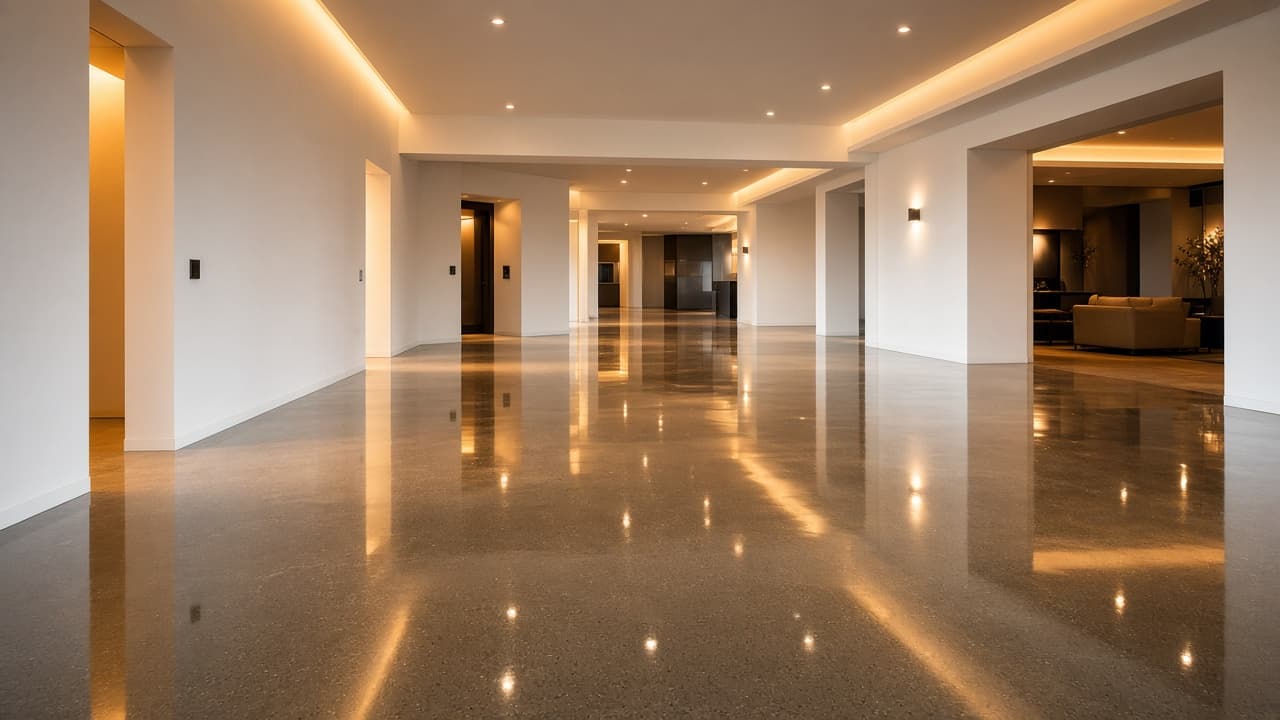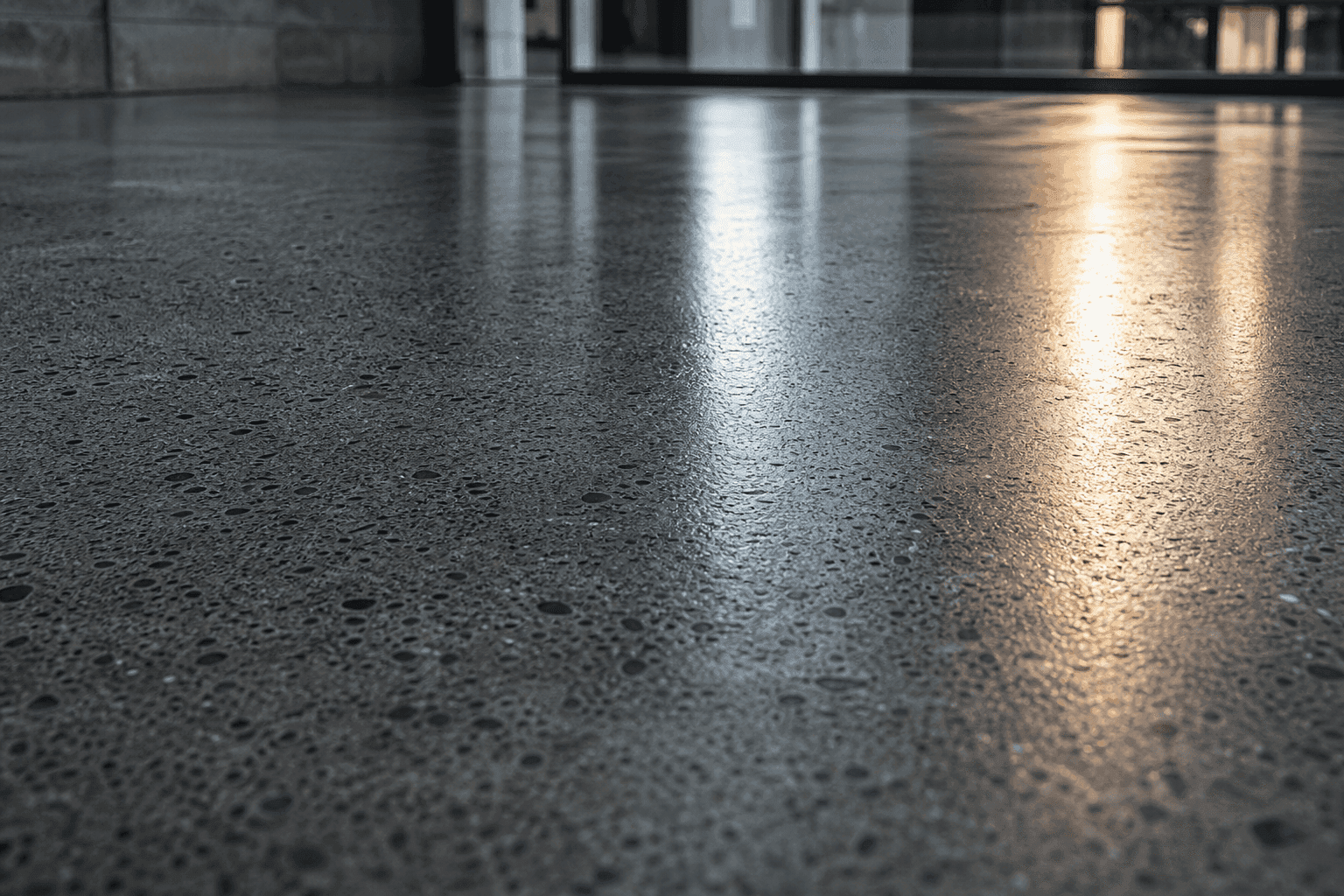
A commercial floor has a harder life than a residential one. More traffic, more equipment, more cleaning chemicals, longer hours of use, and a business that can't just pause for a few days while work happens. Polished concrete has become the go-to floor for commercial spaces precisely because it handles all of that — and does it while looking sharp. This guide walks through what makes a commercial polishing job different from a residential one, how to spec the right finish for different business types, and how to plan a job that doesn't disrupt your operations.
Why commercial spaces choose polished concrete
The business case for polished concrete is straightforward. The upfront cost is competitive with quality vinyl or commercial carpet tile. The ongoing cost is much lower — no stripping and waxing cycles, no tile replacement, no periodic re-coating. A properly spec'd polished floor in a retail or office environment needs only regular dust mopping and occasional damp mopping with a neutral cleaner. That's it. No scheduled maintenance visits, no stripping products, no floor-care staff on a rotation.
Durability is the other driver. Retail floors see millions of footsteps. Warehouse floors see forklifts and pallet jacks. Showrooms need to look immaculate while handling vehicle traffic or heavy furniture moves. A polished slab with the right densifier and sealer handles all of these — it gets harder with traffic rather than softer, because the densifier keeps reacting in the concrete over time.
Specifying the right finish for your business type
Retail and showrooms
Retail floors benefit from a higher gloss — 800-grit and above — because the reflection brightens the space and shows off merchandise. A semi-gloss or high-gloss finish makes a room look larger and more premium without any artificial lighting change. For showrooms with vehicle traffic or heavy display items, we spec a commercial-grade densifier rather than a residential one — it builds a harder surface that won't scratch from display stands or occasional dollies.
Offices and medical spaces
Offices and clinics typically go for a satin finish (400-600 grit) — professional looking without the visual noise of a mirror finish. For healthcare environments, we use a sealer with antimicrobial properties and specify a finish that's easy to clean with hospital-grade disinfectants without breaking down. Seamless surfaces with no grout lines are a genuine hygiene advantage over tile.
Warehouses and light industrial
The spec here is almost entirely about durability and safety rather than aesthetics. A 200-400 grit finish with a heavy-duty commercial densifier creates a surface that resists forklift traffic and pallet jack wheels. We add non-slip aggregate to the sealer in areas where water or liquids are present. We also spec the sealer for chemical resistance if the space handles solvents, oils, or cleaning agents. Line and zone marking can be added after polishing.
Restaurants, cafes, and food service
Food-service floors need to handle grease, moisture, and aggressive cleaning products. We use a food-safe penetrating sealer, build in a non-slip texture, and specify a finish that stays presentable despite the frequent mopping that food spaces require. A matte to satin finish hides the high-traffic wear pattern better than a high-gloss in a kitchen or back-of-house area.
Scheduling around your operations
This is where commercial polishing jobs require more planning than residential ones. The space is usually occupied, and even if you can temporarily relocate staff, there are often fixtures, shelving, or equipment that can't easily move. Here's how we handle it.
- Phased approach: we divide the space into sections and work through them in sequence, so you can keep part of the space operational while we work in another.
- After-hours and weekend work: for businesses that operate Monday through Friday during the day, we can schedule grinding and polishing for evenings and weekends. The dusty grinding stage is done separately from the finishing stage to contain the impact.
- Overnight shifts for fast turnaround: polyaspartic systems cure overnight and are walkable within hours, which makes them the right choice when downtime needs to be minimal.
- Temporary surface protection: if equipment can't move, we work around it and return for those areas once they're accessible.
Dust management in an occupied space
Concrete dust is the main operational concern in a commercial setting. Silica dust is a health hazard, and it settles on products, equipment, and surfaces. We run dust-containment systems on all grinding equipment — HEPA-filtered vacuums connected directly to the grinders — which captures the vast majority of airborne dust at the source. Even so, we recommend sealing off the work area from adjoining spaces, covering sensitive equipment, and planning for a light cleaning pass before reopening.
Ongoing maintenance for commercial polished floors
The maintenance program for a commercial polished floor is what actually determines its lifespan and appearance. The basics are the same as residential but more consistent: daily or frequent dust mopping (auto-scrubbers work well), a weekly or as-needed damp mop with a neutral pH cleaner, and a no-tolerance policy on acidic cleaners. A simple autoscrubber with a red or white pad is the right tool for regular maintenance — it won't damage the finish.
For high-traffic retail or showroom floors, a periodic burnish with a high-speed propane or electric burnisher keeps the gloss level up and re-activates the guard sealer's shine. This is usually quarterly to annual depending on traffic, and it's quick and cheap compared to any re-coating or replacement job.
We work with businesses across Kamloops including along Columbia Street, Tranquille Road, and the surrounding commercial areas. If you're planning a new fit-out, considering a floor upgrade, or dealing with a worn or failing existing floor, give us a call. Commercial concrete polishing quotes are always free.