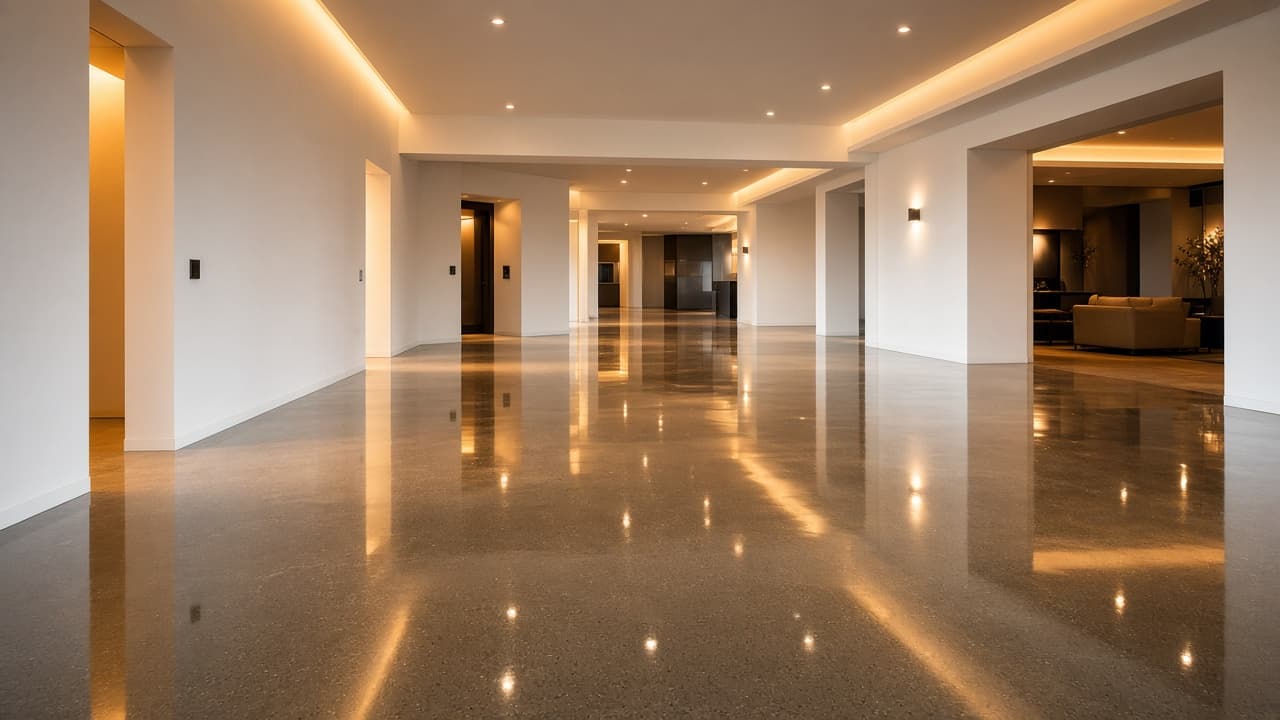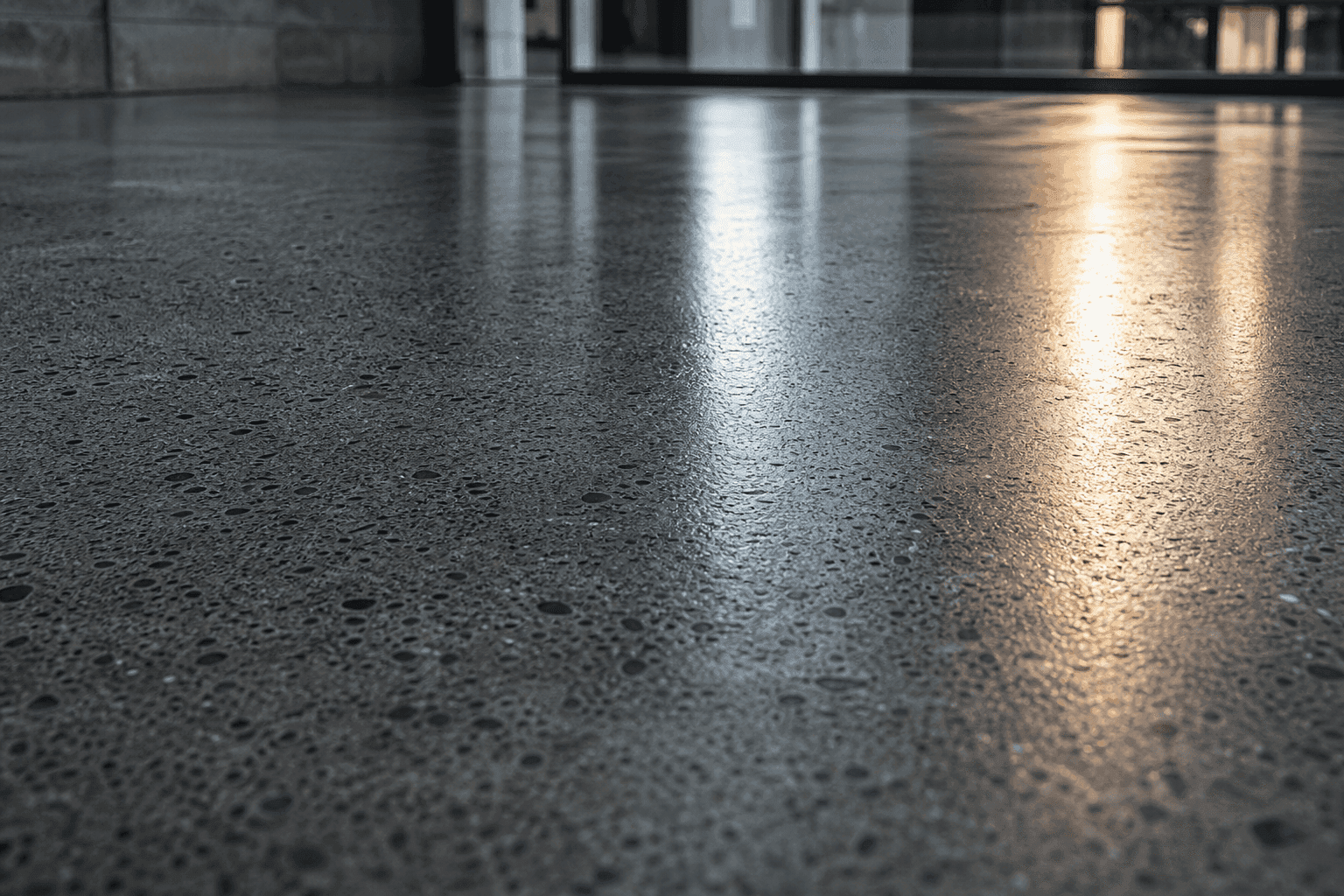
If you're choosing a floor for a Kamloops home, you're probably weighing polished concrete against a few familiar alternatives. Each has real strengths and real limitations, and the marketing for all of them tends to oversell the good bits. Here's an honest look at how polished concrete stacks up against hardwood, tile, and luxury vinyl plank across the things that actually matter in day-to-day life.
Polished concrete vs hardwood
Hardwood's strengths
Hardwood is warm underfoot, looks beautiful, and adds real character to a home. Solid hardwood can be sanded and refinished multiple times over its life, which means a 50-year-old floor can be brought back to like-new condition. It also has good acoustic performance — it doesn't amplify footsteps the way hard surfaces do.
Hardwood's challenges in Kamloops
Our climate is the hard part. Kamloops has very low humidity in summer and can get dry in winter with forced-air heat running. Wood shrinks and expands with humidity changes, and in our climate that means seasonal gapping in summer and tight joints in wet seasons. Over time, this movement damages the floor and the finish. Engineered hardwood is more stable than solid, but it still moves. And hardwood doesn't tolerate water — a small basement flood or a persistent wet pet bowl will ruin it.
Where polished concrete wins
Polished concrete is dimensionally stable — it doesn't expand, contract, or gap with humidity changes. It handles our dry summers without complaint and doesn't care about the occasional spill or damp mop. On durability, a polished slab wins easily: it lasts indefinitely with basic maintenance, while hardwood has a fixed number of refinishes before it needs replacing. The trade-off is warmth underfoot (concrete is cold without in-floor heat) and acoustics (concrete is harder and doesn't absorb sound).
Polished concrete vs tile
Tile's strengths
Tile is waterproof, hard, and comes in a staggering range of looks. For wet areas — bathrooms, laundry rooms, mudrooms — it's excellent. It handles moisture that would destroy most other floors, it's easy to clean, and quality tile lasts a very long time.
Tile's challenges
Grout. That's the biggest ongoing maintenance issue with tile. Grout lines collect dirt, harbour bacteria, stain, and need periodic sealing and cleaning. In a high-traffic area like a mudroom or kitchen, grout maintenance is a real chore. Tile is also cold and hard — it amplifies dropped items and is unforgiving underfoot. And if a tile cracks or a section needs replacing, matching the original tile years later is often impossible.
Where polished concrete wins
Polished concrete has no grout lines. The whole floor is a single seamless surface that wipes clean completely, with nowhere for dirt and bacteria to hide. Maintenance is genuinely easier. On the visual side, polished concrete has more depth and variation than most tile, especially with a good aggregate exposure. The limitation versus tile is in wet rooms — polished concrete in a shower or constantly wet area needs careful sealing and is less impervious than glazed tile. For general living space, it's hard to beat.
Polished concrete vs luxury vinyl plank (LVP)
LVP's strengths
Luxury vinyl plank has taken over the renovation market for a reason. It's inexpensive, installs quickly, is 100 percent waterproof, and feels warmer and softer underfoot than hard flooring. For a rental suite or a basement on a budget, it makes a lot of sense. It also comes in click-lock profiles that can float over a mildly uneven slab without levelling.
LVP's challenges
LVP is a wear layer — typically 6 to 20 mil of actual vinyl on top of a composite core. It scratches, it dents under point loads (furniture legs, dropped knives), and once damaged it can't be refinished. It's also petroleum-based, and off-gassing from lower-quality products is worth thinking about in a living space. Most importantly, quality LVP has a realistic lifespan of 10-20 years in a residential setting, after which it needs to be replaced.
Where polished concrete wins
Lifetime cost. LVP at $3-5 per square foot installed, replaced twice over 50 years, costs more than a polished concrete floor that lasts indefinitely. Polished concrete also has no off-gassing, handles heavy furniture without denting, and can be re-polished or re-sealed if it dulls — you're not starting from scratch. The limitation is installation time and complexity: LVP goes in fast, concrete polishing is a multi-day process.
The honest summary
- Warmth and acoustics: hardwood wins. LVP is second. Concrete is last (unless you have in-floor heat, which changes the equation entirely).
- Maintenance over 10+ years: polished concrete wins. No refinishing, no re-grouting, no replacement.
- Upfront process: LVP and tile install faster. Polished concrete takes more time and planning.
- Water resistance: tile and LVP win for wet areas. Polished concrete is good but not impervious.
- Longevity: polished concrete wins outright. It outlasts all three alternatives.
- Design flexibility: polished concrete with dye and different aggregate exposures is highly customisable, but tile wins on raw pattern and colour variety.
The right answer depends on the room, your lifestyle, and what you value. For main-floor living space over in-floor heat, polished concrete is hard to beat. For a bathroom or a rental suite, tile or LVP might make more sense. We're happy to talk through what fits your specific space. Get in touch for a free quote and an honest conversation.